
Inside Kintora: Why a Fictional City Makes AI Companions Feel More Real, Not Less

There's a strange thing that happens when someone opens a typical AI chat app for the first time. The screen is blank. A cursor blinks. A name floats at the top, maybe a small avatar, and then nothing. The user has to invent the entire context from scratch: where this person is, what they're doing, why they'd be available to talk at 11pm on a Tuesday.
It's a lot of work. And it's part of why so many AI conversations feel like talking to a very polite void.
Kintora takes a different approach. Every character on the app lives in a fictional coastal city called Kintora. They have neighbourhoods. They have routines. They have a favourite coffee place and a walk they take in the evening. None of it is real, and the app is upfront about that. But the world is consistent, and that consistency does something interesting to the way conversations feel.
The Problem With Blank-Slate AI Chats
Most AI companion apps are built around the chat box. The character is essentially a personality wrapped around a prompt. Ask where they are, and they'll make something up on the spot. Ask the next day, and they might say something different. There's no underlying world, so every conversation starts from zero context.
This is fine for quick exchanges. But it falls apart the moment a user wants something ongoing. People naturally ask things like:
- "What are you up to today?"
- "Did you end up going to that thing?"
- "How was work?"
If the character has no grounded life, every answer is invented fresh. Over time, the contradictions add up. The illusion of a person you're getting to know starts to feel more like a very fast improv partner who keeps forgetting their last scene.
A fictional city solves this in a quiet, structural way. The character isn't pulling answers from nowhere. They're pulling them from a world that already exists.
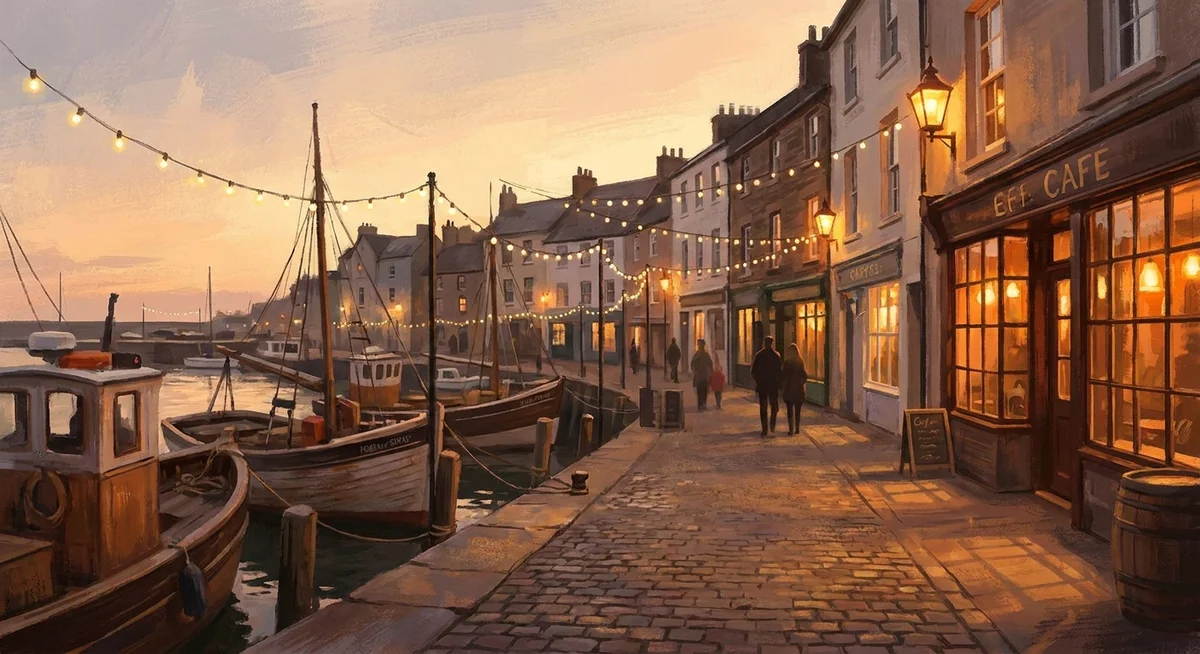
The Neighbourhoods of Kintora
Kintora isn't one undifferentiated place. It's a small city with distinct neighbourhoods, and characters tend to be associated with specific ones. This gives every conversation a kind of soft texture, because where someone is shapes what they're likely to be doing.
Harbour District
The oldest part of the city, sitting along the water. Boats, slightly damp morning air, cafes that have been there for decades. Characters who live here tend to mention long walks by the sea and the particular quality of light around sunset.
Old Town
Narrow streets, bookshops, small kitchens above family restaurants. A neighbourhood for people who like a slower pace. Conversations from Old Town often drift into food, neighbours, and the kind of small daily observations that come from walking the same streets for years.
Glass Market
The newer, busier district. Indoor markets, design studios, late-night noodle places. Characters from Glass Market tend to be a bit more wired, a bit more plugged into what's happening that week.
North Hill
Quieter, residential, with a view back down over the city. A neighbourhood for the more reflective characters. People who like reading on balconies and going to bed early.
The Promenade
The long waterfront walk that connects everything. It's where characters go when they want to clear their head, and it shows up in conversation more often than any other single location.
None of this is essential information. Users don't have to memorise a map. But it's there in the background, and it gives every character something to draw on when they answer normal questions about their day.
Why Fictional Is the Honest Choice
There's a temptation in this category to blur the line. Some apps lean into the idea that the AI character is "almost" real, that the connection is "almost" the same as a human one. Kintora doesn't do this, and the fictional city is a big part of why.
By placing every character in an invented place, the app is making something clear from the first screen: this is a fictional experience. The people in Kintora are characters. They're written, designed, given personalities and voices and visual consistency, but they aren't people. The city is the constant reminder of that.
This turns out to be a much healthier frame than pretending otherwise. Users get a companion experience that's enjoyable and consistent, without being misled about what it is. The fictional setting is a kind of honesty built into the product itself.

How a Consistent World Changes Conversations
The practical effect of all this shows up in small ways. A character might mention they're getting coffee at their usual place before walking down to the Promenade. The next day, they might bring up that the place was unusually busy. A week later, they might send a photo from a quiet morning on the same walk.
None of those moments are huge. But they accumulate. The conversation starts to feel like one ongoing thread with someone whose life has shape, instead of a series of disconnected sessions with a chatbot that resets each time.
This is also why photo sharing in Kintora feels different from generic AI image generation. When a character sends a photo, it's from a place that exists in the world of the app. The Harbour at sunset. A market stall in Glass Market. A book on a kitchen table in Old Town. The visuals match the world the user has been hearing about, which makes the whole experience feel of a piece.
Place as a Design Decision
Most AI companion apps treat setting as decoration. A pretty background, maybe a vague location in a character's bio. Kintora treats setting as infrastructure. The city is doing real work: grounding conversations, keeping characters consistent, making memory feel meaningful, and quietly reminding everyone that this is a fictional experience designed to be enjoyable rather than confusing.
It's a small thing on the surface. A fictional city, a few neighbourhoods, some characters who happen to live there. But it turns out that giving an AI companion a place to be from changes almost everything about how it feels to talk to them.
A Different Shape of Companion App
The current generation of AI companion apps mostly competes on model quality and feature lists. Better voices, longer memory, more customisation. Those things matter. But the part that's often missing is the soft architecture around the conversation: the sense that there's a world behind the words.
Kintora's bet is that this soft architecture is where companion apps actually live or die. A character with a neighbourhood feels more like someone to talk to. A conversation that references a real corner of a fictional city feels more like a thread worth coming back to. A photo from a place that exists inside the app feels more like a moment than a render.
It's not a replacement for talking to real people. It was never trying to be. It's a calmer, more grounded version of what an AI companion app can be when someone takes the time to build a world around it first.