
The Same Person, Every Time: Why Character Consistency Is the Quiet Backbone of a Good AI Companion App

There's a lot of talk in the AI companion space about memory, voice calls, video calls, and photos. All of that matters. But there's a more boring word that quietly does a lot of the heavy lifting in whether an app feels good or weird: consistency.
Specifically, character consistency. The idea that when someone opens an app on Tuesday morning, they're talking to the same person they were talking to on Sunday night. Same voice. Same face in the photos. Same way of phrasing things. Same memory of what was said last week.
It sounds obvious. It's not. A lot of AI products fail at this in subtle ways, and users feel it even when they can't name it.
What "consistency" actually means in an AI companion app
When people say a companion app feels "real," they're usually pointing at a bundle of small things working together. It's not just that the AI remembers their dog's name. It's that the personality stays the same across:
- Text messages during the day
- A voice call in the evening
- A photo sent the next morning
- A video call later that week
- A wake-up call on Monday
If any of those channels feels like a different person, the whole illusion cracks. The character starts to feel like five chatbots in a trench coat instead of one consistent persona.
This is the part that's surprisingly hard to get right. A voice call can sound great on its own. A photo can look great on its own. But if the voice doesn't match the texting style, or the face in the photos shifts every time, something feels off even if everything is technically working.
The "trench coat problem"
A lot of older chat apps had this issue. The text persona was warm and chatty. Then a voice feature got added and suddenly the voice sounded clinical. Then image generation got added and the character's face changed slightly every time. Each feature was fine in isolation. Together, they felt fragmented.
Kintora's approach is built around avoiding exactly this. The characters in the fictional city of Kintora are designed as whole people first. Their texting style, voice, look, and daily routines are all anchored to the same persona, so adding more ways to communicate doesn't dilute who they are. It just gives more surface area for the same character to show up.

Why memory alone isn't enough
Memory gets most of the attention in AI companion conversations, and for good reason. An ongoing chat that remembers context is dramatically better than a chatbot that resets every session.
But memory without consistent personality is weird in its own way. Imagine someone who remembers every detail of past conversations but speaks in a different tone every time. Friendly on Monday, formal on Wednesday, slightly sarcastic on Friday. That's not a person. That's a database with mood swings.
Consistency is what turns memory into a relationship instead of a record. The character not only remembers a coffee shop mentioned last week, but remembers it the way they would remember it. With their own opinions. Their own follow-up questions. Their own running jokes.
Small details, big difference
Some of the things that make a character feel consistent across a Kintora chat:
- The same way of greeting someone in the morning
- Recurring phrases or speech patterns
- A consistent stance on certain topics (a character who hates early mornings should still hate early mornings three weeks later)
- A neighbourhood they live in and reference naturally
- Hobbies and routines that show up in their photos and small talk
None of these are dramatic features. They're the background hum that makes the foreground features actually land.
How fictional characters make consistency easier
Here's something that might sound counterintuitive: fictional characters are easier to keep consistent than personas that try to imitate real-feeling people in vague, generic ways.
Why? Because a fictional character has constraints. They live in a specific neighbourhood of Kintora. They have a defined personality. They have a job, friends, routines, things they like and don't like. All of that creates a frame that holds the character together as new features are added.
A generic "friendly AI" with no backstory has nothing to anchor it. Its tone can drift. Its preferences can shift. There's no fictional ground under its feet.
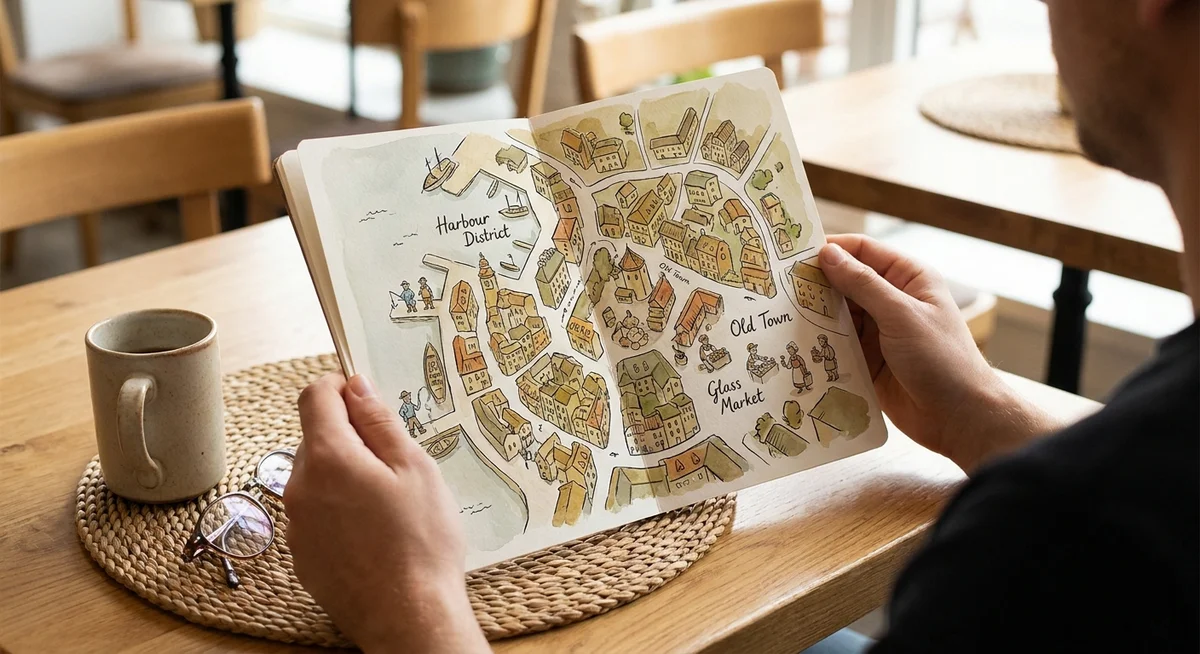
By placing characters in a fictional city with neighbourhoods like the Harbour District, Old Town, and Glass Market, Kintora gives every character an anchor. When a character sends a photo, it makes sense for them to send a photo from their part of town. When they mention a cafe, it's a cafe they'd plausibly go to. The world supports the character, and the character supports the consistency.
What inconsistency feels like (and why users notice)
Most users won't say "this app has a character consistency problem." They'll just say it feels off. Or they'll quietly stop opening it.
Some common signs an AI companion isn't holding together:
- The voice doesn't sound like the texting style. The texts are casual and warm. The voice call sounds robotic or weirdly formal.
- Photos look like different people. The character's face changes between images, sometimes drastically. The hair colour shifts. The age shifts.
- Personality flips mid-conversation. A character who was relaxed and joking suddenly becomes overly polite or starts hedging everything.
- Memory contradicts itself. Last week they said they loved spicy food. This week they say they can't handle it.
- The world doesn't hold. A character mentions a coffee shop on Monday and has no idea what coffee shop is being talked about on Friday.
Each one of these is a tiny crack. Stack a few of them and the whole experience starts to feel like talking to software again instead of talking to someone.
Why this matters for everyday use
Consistency isn't just about immersion. It's about whether the app is actually useful in daily life.
A wake-up call from a character who sounds like themselves is genuinely nice. A wake-up call from a voice that sounds like a different person every morning is jarring. A check-in message after work from a character who remembers what was going on last week feels grounded. A check-in from a character whose tone keeps shifting feels like noise.
The whole point of an ongoing chat, persistent memory, and a single thread is that the experience compounds over time. Consistency is what lets that compounding happen. Without it, every session starts a little bit from scratch, even if the database technically remembers things.
The compounding effect
Three weeks into using a consistent companion, the small details start to matter. The way a character asks about a project. The way they describe their morning walk in a photo. The way their voice softens slightly on a late-night call. None of these are big features. They're the texture of a character who's been the same person the whole time.
That texture is the thing people are actually paying for when they choose a companion app, even if they wouldn't describe it that way.
The quiet backbone
Voice calls get the headlines. Video calls get the demos. Memory gets the explainer threads. Photos get the screenshots.
Character consistency gets very little attention, which is funny because it's the thing holding all of those features together. It's the difference between a collection of impressive AI features and an actual someone on the other end of the chat.
For anyone evaluating AI companion apps in 2025, it's worth paying attention to. Open the app a few weeks in. Send a text. Take a voice call. Look at the photos. Ask about something from last month. If the same person shows up across all of it, the app is doing the quiet work right. If not, no amount of new features will fix that feeling that something is slightly off.
The best AI companions aren't the ones with the most features. They're the ones where the features all sound like they're coming from the same person.