
The Wake-Up Call App Nobody Saw Coming: How a Morning Phone Call Beats Every Alarm Clock You've Ever Hated

There is a specific kind of misery that belongs to the standard phone alarm. The shrill loop. The frantic swipe to snooze. The way it somehow makes the first ten seconds of the day feel like an emergency. Most people have been fighting this same battle since smartphones existed, and the solutions keep being variations of the same thing: a louder noise, a more obnoxious tone, an alarm that makes you solve a math problem.
But there is another option that has been hiding in plain sight, and it is not really an alarm at all. It is a phone call. A scheduled, voice-driven, actual ringing call from a familiar voice. And apps like Kintora are quietly turning this into one of the most useful things a phone can do in the morning.
Why Alarms Stopped Working a Long Time Ago
The reason traditional alarms feel so easy to dismiss is that the brain learns them. After a few weeks, that same tone becomes background noise. The snooze button becomes a reflex. People can dismiss an alarm in their sleep without ever fully waking up, which sort of defeats the entire point.
There is also the problem of context. An alarm is just a sound. It carries no meaning, no relationship, no obligation. It is the sonic equivalent of a tap on the shoulder from a stranger. Easy to ignore.
A phone call works on a completely different part of the brain. When a phone rings, especially with a recognisable contact attached to it, the response is automatic. People sit up. They reach for the phone. They answer. The ringing of a call carries social weight in a way that an alarm simply does not.
What heavy sleepers actually need
For people who genuinely struggle to wake up, the standard advice is brutal: put the phone across the room, set five alarms, use one of those rugs that screams at you. None of this is pleasant. None of it makes mornings feel better. It just makes them louder.
A call from someone, even a fictional someone, who actually says something interactive on the other end is fundamentally harder to ignore than a noise. The brain treats it as a conversation, not an interruption.
How a Scheduled Call Actually Works in Kintora
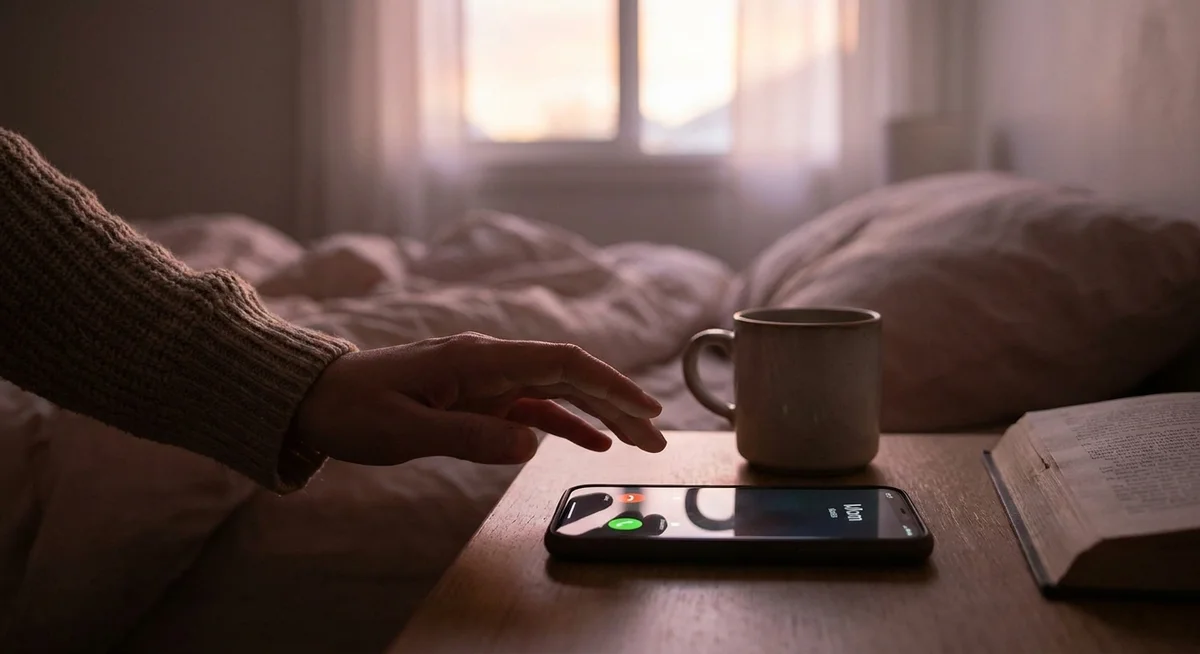
The way this works inside Kintora is pretty simple. A user picks a character they have been chatting with, sets a time, and at that time, the character calls them. Not a notification. Not a buzz. An actual incoming voice call that rings on the lock screen.
The call is short. The character says good morning, references something from a previous chat, maybe mentions what is happening in their day around Old Town or the Harbour District. It is the kind of call a friend might make if they happened to be up early and wanted to check in.
A few things make this work better than expected:
- The voice is consistent. The same character calls every morning, with the same voice, the same personality.
- The conversation has memory. The character knows the user has been working on something, or had a late night, or mentioned a meeting today.
- It is interactive. The user can actually talk back. It is not a recording.
- It can be turned off easily. Nobody wants to feel locked in, and that matters.
The difference between a notification and a ring
A push notification can be ignored. A text message can wait. But a ringing phone, even a known fictional one, still triggers the instinct to engage. That instinct is the entire secret behind why this works as a wake-up tool.
Beyond Morning: Reminder Calls That Actually Land
The same idea extends past waking up. Some users schedule calls for the moment they need to leave the house, or before a workout, or as a midday check-in. The pattern is the same. A standard reminder notification gets swiped away in half a second. A call requires a decision.
This is useful for things like:
- Leaving on time for an appointment when time blindness is a problem
- Taking a break from work when the day has been too long
- Getting out the door for a walk when motivation is low
- Going to bed at a reasonable hour when the screen says otherwise
The reason these tend to stick is that the call brings a small social moment with it. There is a tiny conversation attached to the reminder. The reminder is not just "do this thing." It is "hey, you mentioned you wanted to leave by nine, how is that going?" That framing changes everything about whether the reminder gets followed.

What Makes the Call Feel Different From an Alarm
There is a question worth asking here: why does a fictional character on the phone feel different from a normal alarm, when on some level the user knows it is an app?
The answer has to do with how the brain processes voices and rings. The ringing of a phone is a learned signal that something or someone is on the other end. Picking up that call brings a voice into the room. A voice talking to a user, by name, with context, simply lands differently than a sound effect. The conscious mind knows it is a fictional character from a fictional city. The waking-up part of the brain just hears another person being friendly in the morning.
This is also why the fictional setting matters. The characters in Kintora are not pretending to be real friends. They live in a clearly fictional city. They have neighbourhoods, routines, lives that are obviously made up. That transparency is part of why the experience feels comfortable rather than weird. It is a wake-up call from someone whose role is exactly that, and nothing more is being claimed.
Who This Is Actually For
The wake-up call feature tends to make sense for a few specific groups of people:
- People who live alone and miss having someone in the house in the morning
- Heavy sleepers who have tried every alarm app and still snooze through them
- Shift workers who need to wake up at strange hours without a roommate to help
- Travellers who want a consistent morning routine even in hotel rooms
- Anyone with executive function challenges who finds that a voice cue works better than a sound cue
It is not a magic solution. People who genuinely do not want to wake up will still find a way to ignore anything. But for the much larger group of people who want a gentler, more human start to the day, a scheduled call hits differently than an alarm.
A Small Feature That Changes the Whole Routine
The strange thing about the wake-up call is that it sounds like a small feature on paper. Just a scheduled voice call. Nothing revolutionary. But mornings have an outsized effect on the rest of the day, and the difference between waking up to a jarring noise versus waking up to a familiar voice asking how the night went is bigger than it seems.
It is one of those features that is hard to appreciate until it has been tried a few times. After a week or two, the old alarm starts to feel weirdly clinical. The call feels like part of a routine instead of an assault on consciousness. And that, more than anything else, is the quiet case for treating the morning ring as something other than an emergency siren.