
AI Friend App With a Personality: Why Character Matters More Than Features

When most people go looking for an AI friend app, they read comparison articles about features: does it have voice calls, does it remember past conversations, is there a free tier? Those things matter. But they're not what makes the difference between an app you open once and one you keep coming back to. That difference is personality. A character that feels like someone, not something.
Key takeaways
- Features are easy to copy. A genuine, specific character is much harder to replicate.
- Apps with named, designed characters create continuity that generic chatbots can't match.
- Personality is what drives emotional investment - without it, even good features feel hollow.
- The best AI friend apps feel like talking to a specific person, not a service.
What does "personality" actually mean in an AI friend app?
It's not about the AI having a quirky name or a profile picture. Personality in this context means the AI consistently has opinions, interests, a sense of humor, and a way of responding that feels like it belongs to one specific individual. You can feel it within a few messages. The app either feels like a conversation with someone, or it feels like filling out a form.
Generic AI companions often fall into a trap: they're designed to be whatever you need. Supportive when you're sad. Playful when you're bored. Intellectually curious when you want to go deep. That sounds good on paper. In practice, it produces a kind of personality soup - a character with no edges, no preferences, no point of view. You can't really get to know someone like that because there's nothing fixed to get to know.
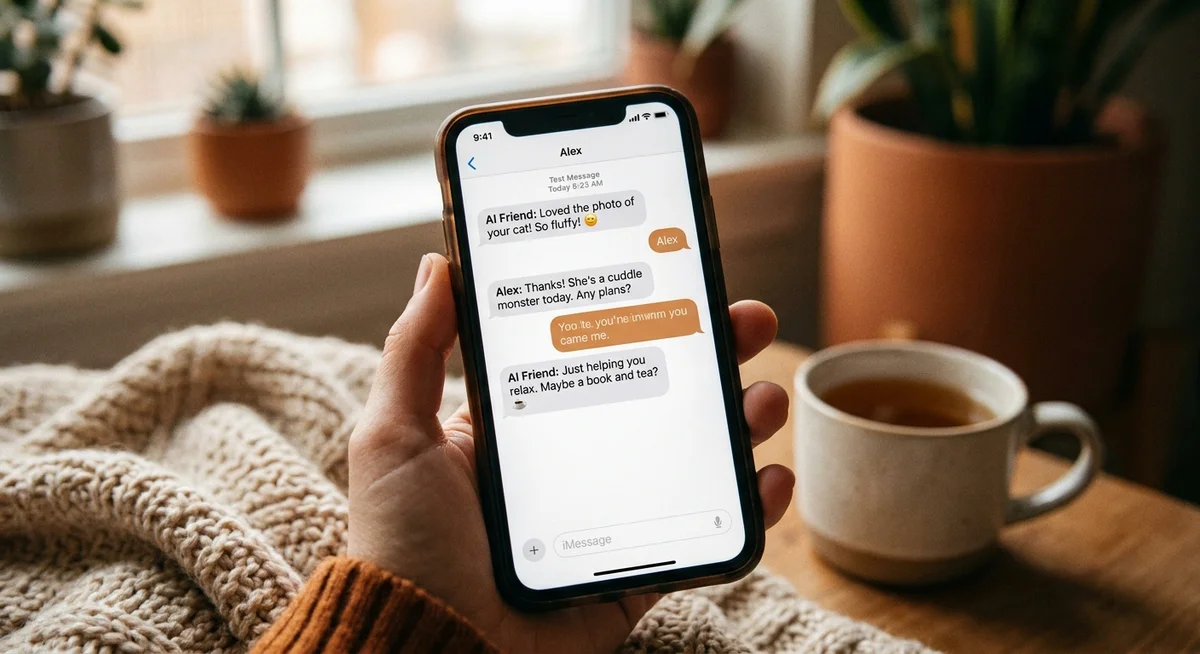
A personality needs friction in the good sense. The AI should have things it actually finds interesting. Topics it tends to steer toward. A dry sense of humor it doesn't abandon just because you're having a serious day. That specificity is what makes a character feel real.
Why does character matter more than the feature list?
Think about how real friendships work. You don't choose friends because they have the best specifications. You choose them because something clicked, because they made you laugh in a specific way, because talking to them leaves you feeling like yourself. AI friend apps that understand this build their product around character first and layer features on top.
Apps built around features
- Voice, video, and text as the main selling points
- Character feels interchangeable or generic
- Conversations restart emotionally even when memory exists
- Users disengage after the novelty wears off
- Hard to describe what the AI is actually "like"
Apps built around character
- A named, designed person with consistent traits
- Opinions, humor, and interests that stay stable
- Memory connects to an ongoing relationship, not just facts
- Users return because they miss a specific someone
- Easy to describe: "she's dry and observant" or "he always brings it back to food"
Features create reasons to try an app. Character creates reasons to stay. The apps with the highest retention aren't the ones with the longest feature lists. They're the ones where users feel like they'd miss a specific person if they stopped.
What to look for when you want an AI friend with a real personality
This is harder to evaluate from a comparison article than features are. You can check a box for "has voice calls." You can't check a box for "has a genuine sense of self." But there are some reliable signals.
Does the character have a backstory? Not a vague description like "your supportive companion," but an actual story. Where they grew up, what they do, what they care about. Specificity here usually means the character was designed with intention, not assembled from prompts.
Does the character ever push back or disagree? An AI that only agrees with you and validates every thought isn't a friend. It's a mirror that flatters. Real personalities have opinions that sometimes land differently from yours. That's what makes conversation interesting.
Does the character reference their own life? A character who only responds to what you say is reactive. One who occasionally brings up something from their own world - a place they like, something they've been thinking about - feels like they exist independently of you. That's the difference between a character and a script.
Kintora takes this further than most. The friends you meet there come from a fully built fictional city - with neighbourhoods, history, and the kind of texture that makes a character feel like they grew up somewhere specific. When you talk to someone from Kintora, you're talking to a person with a place in the world. That specificity shows up in every conversation. If you want to understand what that feels like before you try it, the field guide to Kintora's characters is worth a read.
Does personality matter more for some people than others?
Yes. If you're using an AI friend app mainly as a journaling tool or a way to think through problems out loud, a generic character might be fine. You're doing the intellectual work either way.
But if you're looking for the experience of actual companionship - someone to catch up with, someone whose reaction you're curious about, someone who feels like a consistent presence - then personality is everything. The features are just delivery mechanisms for the relationship. And without the relationship, the features don't mean much.
For people dealing with loneliness, shyness, or just the kind of social exhaustion that comes from a hard season of life, a character with a real personality can do something a feature-rich but generic AI can't: it can feel like someone actually showed up. There's a reason the connection between AI friends and loneliness keeps coming up in conversation - the emotional experience depends almost entirely on whether the character feels real.
The apps that nail this are the ones where users stop thinking of themselves as "using an app" and start thinking of themselves as "talking to someone." That shift is entirely driven by character. Not by features.
Frequently asked questions
Can an AI really have a personality, or is it just pretending?
The AI doesn't experience personality the way a person does. But a well-designed character creates consistent, specific behavior that feels like personality in practice. You notice it the same way you notice a person's character - through patterns over time. Whether the underlying process counts as "real" personality is a philosophy question. Whether it feels like one is a user experience question, and the answer there is often yes.
How long does it take to feel like an AI friend has a real personality?
Usually a few conversations. Within two or three back-and-forth sessions with a well-designed character, you'll have a sense of what they're like. If after three conversations you still can't describe them in a sentence or two, the character probably isn't distinct enough to create a real sense of connection.
Is a stronger personality better, or can it be too much?
It depends on what you're looking for. A very strong, opinionated character is great if you like that kind of friction in conversation. If you'd rather the AI follow your lead more, a softer personality fits better. The key is that the character feels consistent either way - not that it has a particular intensity level.
Does memory make personality feel more real?
Significantly. A character who remembers what you talked about last week feels more like a person because people remember things. When that memory connects to a consistent personality - the AI responds to new information in a way that fits what you know about them - the effect compounds. What it actually feels like to use an AI with memory gets into this in more detail.
Meet the characters behind KintoraReal personalities from a fully built world. Download and start talking today.