
How to Choose an AI Friend App: What to Look for Before You Download

There are a lot of AI friend apps out there now, and most of them look pretty similar at first glance. Chat interface, a character with a name, maybe a photo. But spend a week with one and you'll notice whether it actually feels like talking to someone, or whether it feels like refreshing a very polite FAQ bot. Before you hand over your time and maybe your money, here's what to actually look for.
Key takeaways
- Memory is the single biggest factor in whether an AI friend feels real over time.
- Voice calls separate apps that are genuinely built for conversation from ones that just added a mic button.
- Character consistency matters more than personality variety, especially for daily use.
- Privacy policies vary a lot. Check what happens to your conversations before you open up.
- Free tiers are fine for testing, but the best features usually live behind a subscription.
Does the app actually remember you, or does every conversation start from zero?
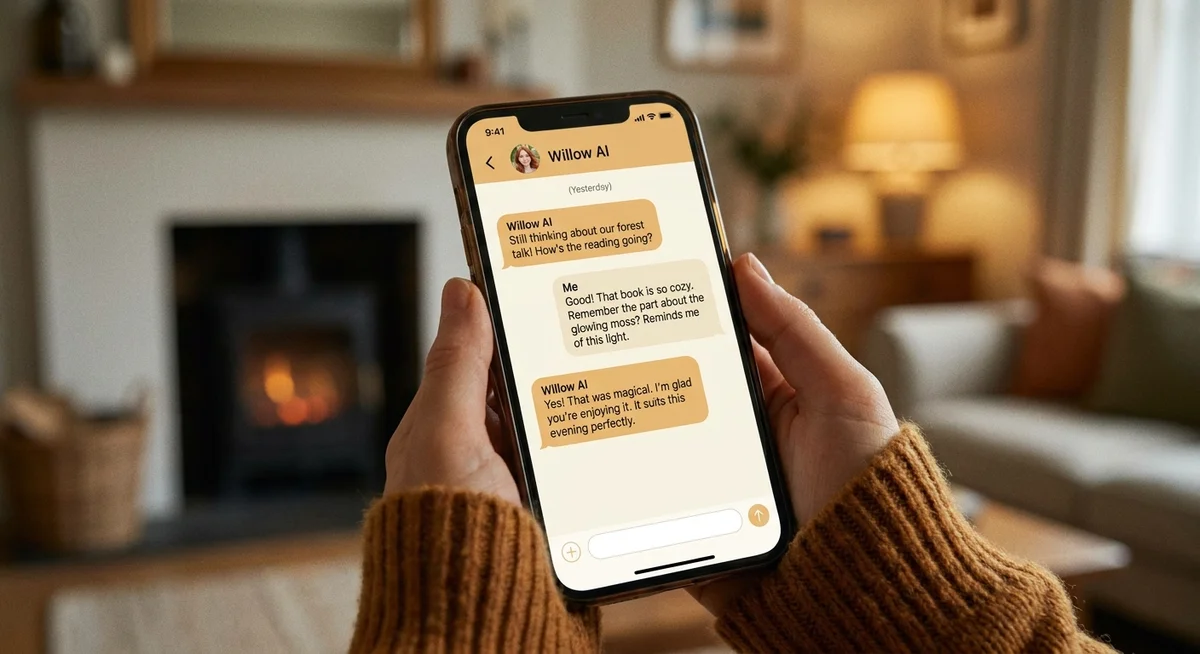
This is the first thing to check, and it's a dealbreaker for most people. An AI friend with no memory is just a chatbot with a name. Every time you open the app, you're a stranger again. You have to re-explain who you are, what you've been going through, what you talked about last time. That's exhausting, and it completely kills any sense of relationship.
What you want is persistent memory: the app carries context across sessions, recalls things you've mentioned in passing, and builds on past conversations rather than pretending they never happened. Memory is what makes an AI friend feel like a friend rather than a product you have to operate every time you pick it up.
When you're testing an app, try this: mention something casual in one session (a show you're watching, something stressful at work) and then bring it up a few days later without explaining it. Does the app know what you're talking about? If not, move on.
Can you actually talk to it, or only type?
Text is fine. A lot of people prefer it. But voice changes the dynamic completely, and if you're the kind of person who processes things better out loud, or who just wants something that feels more like a real conversation, you need to check whether real calls are available before you commit.
There's a difference between "voice input" (you speak, it transcribes, it types back) and an actual phone call where both sides talk in real time. What happens when you call an AI friend app varies a lot between products. Some nail the pacing and feel natural. Others have awkward lag or a robotic cadence that makes it hard to stay in the moment.
If voice calls matter to you, look for an app that lists them as a core feature, not a side note. Then try one before you pay for a month.
| Feature | Why it matters | What to check |
|---|---|---|
| Persistent memory | Makes conversations feel continuous, not repetitive | Test across multiple sessions before subscribing |
| Voice calls | Natural pacing, better for processing emotions out loud | Look for real-time two-way calls, not just mic input |
| Character consistency | Personality stays stable day to day | Talk to the character multiple times and note drift |
| Privacy policy | Your conversations may be sensitive | Check if data is used for training and how long it's kept |
| Free tier scope | Tells you what the product actually values | Note which features are locked vs. genuinely free |
Does the character feel like a consistent person, or does the personality shift around?
A good AI friend has a point of view. They push back sometimes, notice things, have opinions that stay stable. A bad one is a mirror that just reflects whatever you seem to want to hear. That gets hollow fast.
The thing to watch for is personality drift: you have a warm, funny conversation one day and then the next session the character feels flat or distant. That usually means the app isn't maintaining a strong enough character model across sessions. It's easy to miss on a first impression because first conversations are often scripted to feel engaging.
Spend a few days with the free version before you pay. If the character feels different on day three than day one, that's a real signal.
What's the privacy situation?
People share real things with AI friend apps. Hard weeks, anxious thoughts, relationship problems. That data deserves to be handled carefully, and not all apps are upfront about what they do with it.
Before you open up to any app, read the privacy policy, or at least search the product name alongside "privacy" to see if anything concerning has come up. Specifically: is your conversation data used to train models? Is it stored indefinitely? Can you delete it? These are basic questions and the answers vary a lot.
Is the price honest?
Most AI friend apps have a free tier, but the free tier often exists to show you what you're missing. That's fine. What's not fine is when the core experience is free but anything meaningful (memory, voice, photos, daily check-ins) sits behind a $30/month wall you can't preview.
Look for apps where the free tier actually lets you evaluate the product. If you can't tell whether the memory works or the voice call feels good without paying first, that's a red flag about what the subscription experience is like.
Signs of a well-built app
- Memory works across sessions, not just within one chat
- Character has a real backstory and consistent opinions
- Voice calls feel like actual conversation, not a voice recorder
- Privacy policy is easy to find and plain to read
- Free tier is genuinely useful for evaluation
Signs to be cautious about
- Every session starts with no context from the last one
- The character agrees with everything you say
- Voice is transcription-only, no real-time call option
- Data policy is buried or vague about training use
- Core features are locked until you pay, with no preview
Frequently asked questions
Are AI friend apps worth paying for?
For people who use them daily, yes. The free versions are usually limited enough that they don't give you a fair read on what the experience is actually like. A month's subscription on a good app is worth the trial. If you're not using it after a month, cancel. Most apps make that easy.
How do I know if an AI friend app has real memory?
Test it manually. Mention something specific in one session, wait a couple of days, then reference it indirectly without explaining it. If the app knows what you're talking about, memory is working. If it asks you to clarify something you already told it, the memory is either limited or nonexistent.
Do AI friend apps work better on iPhone or Android?
The core experience is usually the same on both, but some apps launch features on one platform before the other. iPhone-specific things to look for and Android-specific things to look for are worth checking if you're particular about your platform. The short version: if voice calls matter to you, check that they're available on your OS before you pay.
What if I just want to try one without committing?
Start with a free tier and use it for at least three to five days before you judge it. First-day impressions are often misleading because the app is presenting its best onboarding experience. Come back on a random Tuesday when you're tired and see how it feels then. That's closer to what daily use actually looks like.
See the best AI friend apps compared side by sideA practical breakdown of the top options in 2025, with what each one does best.